2026 Gratitude Postcard Series
We are pleased to share more information about the art and artists that make up this year’s Gratitude Postcard series for the Northampton Survival Center!
This year, twelve local artists were prompted to create art for the Survival Center reflecting “Community.” Their designs make up the 2026 gratitude postcard set sent to members of our Bread & Butter Club. The club is made up of supporters who give automatic, recurring monthly donations, which provide a steady, reliable source of funding, ensuring the Center can fulfill its mission of providing food and other essential resources to low-income individuals and families throughout Hampshire County.
We love our Gratitude Postcard Project for many reasons, and hope you do too! In addition to helping us say thank you to our monthly donors, the postcards allow us to share the work of local artists, celebrate community, and get the word out about the important work of the Northampton Survival Center. All artists are provided with an honorarium from the Mo and Cher Willems Foundation as thanks for their work on this project.
You can support the Center’s good work with a monthly gift by joining the Bread & Butter Club! Your donation will help provide nutritious groceries to our clients and you’ll receive a set of beautiful postcards every year in January. Visit northamptonsurvival.org/breadandbutter for more details, and read on to learn more about this year’s featured artists.

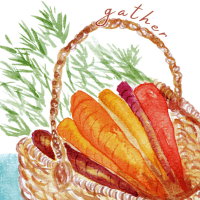
Dane Kuttler had a strong start as a visual artist in preschool, but gave it up when she learned to read. After a multi-decade break from the medium, she decided to embark on a project to “do something I stink at” every day for a month and chose drawing. A year and a half later, she’s migrated to watercolors (a medium notable for making your paintings look like they were done by toddlers) and still tries to make art every day.
It took her 25 drafts to make this postcard. It morphed through a bunch of different styles and designs, including “carrots that look like they’re dueling,” “carrots that look like a children’s cartoon about morality,” and “carrots that definitely have shadows.” Not once during this process did it occur to her to look at a real, actual carrot. Nevertheless, she’s grateful to be included among the real artists, kind of like the veggie burger that’s just happy to have a place on the grill.
When Dane isn’t stumbling her way through making paintings of vegetables, she writes poems for people on her vintage typewriter, tells stories, STILL wears a mask everywhere in public and regularly COVID tests, and has at least two people over for dinner every week so she doesn’t drown in leftovers.
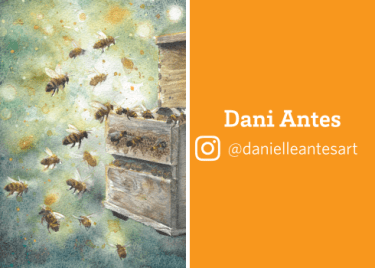
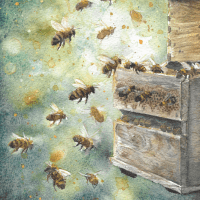
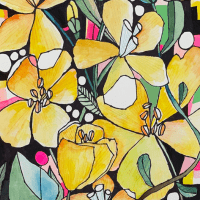
Dani Antes is a self taught, queer artist living in Chicopee, MA. After attending Longy School of Music she where she studied vocal performance, Dani rediscovered her passion for painting. Working primarily in watercolor and linocuts, she enjoys exploring the stark contrast between the two mediums. Dani’s work is deeply inspired by the beauty of both the Pacific Northwest where she was raised and Massachusetts where she currently resides. Capturing bees, tiny creatures, and dreamy landscapes, she hopes her work reminds people to pause and enjoy the little moments of light, beauty, and maybe even magic that surround them everyday.
Dani believes community is a network of helping hands, of support, and often of joy. Her piece for this project features honey bees to represent community because “they capture the true magic of community. Each small act, when we work together towards a common goal, can create something incredible. Just as honey bees collecting pollen have a butterfly effect on the world, when we all chip in, we impact not just our local community but also the world.” She wants you to remember that the little works, the small kindnesses that we each do, when put together, can lead to big things.
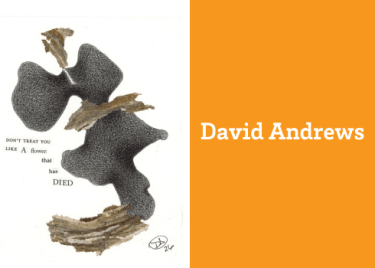
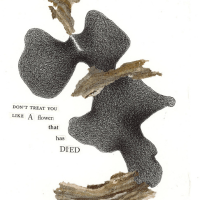
David Andrews is a Chicago-born artist currently living and working in Western Massachusetts. If you’ve visited the Smith College Museum of Art, you’ve likely met David at the front desk, where he has worked as a Gallery Assistant for more than two decades.
David calls his works “emotion-provoking sculpture on paper.” His piece for the Northampton Survival Center’s Gratitude Postcard Project is titled “Not to be Tossed.” It is part of his Small Thoughts series.
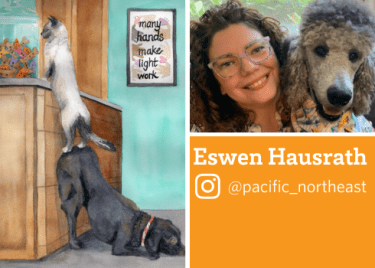
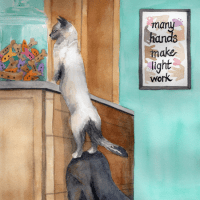
Eswen Hausrath’s art is notable for its communication of a profound love of dogs (which appears to be genetic because an Italian greyhound is on her family crest!). She likes to think about the world through the eyes of a dog—an animal that has evolved alongside humans and offers so much to us across so many contexts.
Eswen tries to balance some sense of realism in her art with some freedom to explore the fantastic effects watercolor allows. She has no formal training, but has used community and online classes to better understand how to compose and approach watercolor, and tries to enjoy the process of creating and the overall effect of her work, rather the technical excellence.
Currently, Eswen is learning more about composition and conveying a sense of depth of space and depth of color. She is thrilled to contribute to a project about community at the Northampton Survival Center because community means support in bad times and togetherness in celebration. Her piece is entitled “Many hands make light work,” after one of her favorite sayings.
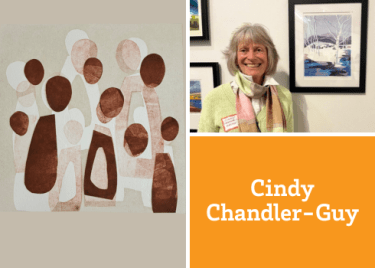
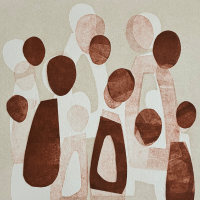
Like many people, Cindy Chandler-Guy’s life’s journey has been filled with many twists and turns, but art and psychology have always been two distinct, but essential passions.
Cindy has an undergraduate degree in Art and a Master’s in Studio Art from NYU focused on sculpture and photography. She moved to the Valley in 1971 to pursue a career in psychology but got sidetracked and built a business making and selling a line of functional stoneware to over 150 stores across the country. She was an original member of the Asparagus Valley Potters’ Guild.
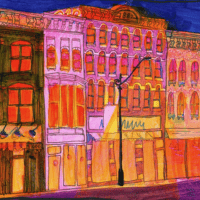
Eventually, Cindy went back to school to get her MSW and has spent over 40 years as a psychotherapist in the Valley. To integrate her passion for art back into her life, Cindy began renting space in The Arts and Industry Building in Florence to explore watercolors, pastels, and oils. In more recent years, she has been engrossed in printmaking—making monotypes and monotype collages—and working with pastels. She loves having the balance and harmony at this time in her life of creating art and doing psychotherapy.
Cindy’s piece for the postcard project is a monotype. Monotypes let her explore working abstractly and conceptually with color and shapes, and are inspired by landscapes, cityscapes, and still life forms. She utilizes colors, shapes, textures, patterns and the layering of multiple inked papers with different markings and degrees of transparency as dominant forces in the pieces in order to create impressionistic and playful compositions. She loves incorporating and “recycling” portions of the papers that she has inked for past prints into current ones, and the challenge of creating “a finished puzzle” by arranging the variant pieces of the collage together to form a coherent composition.
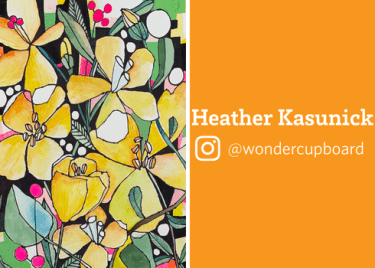
Heather Kasunick, born and raised in Springfield, is an artist and educator now living in Florence. Heather graduated from Massachusetts College of Art and Design (BFA), and University of Massachusetts, Amherst (MFA). After teaching Studio Art at West Springfield High School for over 20 years, she continues her teaching practice at community art spaces. She is a recipient of the Pioneer Valley Excellence in Teaching Award and grants from the Northampton Arts Council.
Heather made hundreds of drawings for the bestselling Unbored series of books for children. She has exhibited her drawings and mixed media work at the Brattleboro Museum of Art, Fitchburg Museum of Art, Katonah Museum and many other spaces. Heather has been volunteering at Northampton Survival Center since 2024.
To Heather, “community” means uniting with others for a shared cause. This sharing, strength in numbers, and organized joy inspired Heather’s contribution to the Gratitude Postcard Project, titled “Community Garden.”
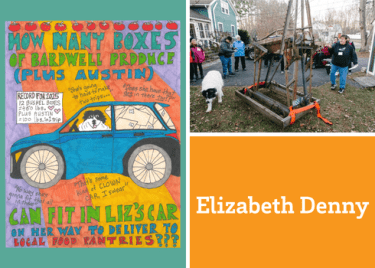
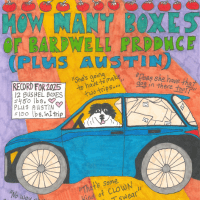
Elizabeth Denny retired a few years ago from a long career as a marketing research consultant, during which time she always made art but never full-time. She has found retirement to be sorely lacking, and now has several jobs including teaching stained glass to pregnant and parenting teens in Holyoke, teaching art to a local teenager with disabilities, and working the farm stand at Bardwell Farm in Hatfield during the summer. For the past two years, she has created a calendar highlighting things people say at the farm stand that boggle the mind: do we sell sweet corn in January? Do we grow pineapples? The calendar is sold as a benefit for the farm and the Northampton Survival Center—that she considers to be the biggest highlight of her artistic career to date! Her piece for this postcard series was featured in the Bardwell calendar.
Liz says, “To me community is something you do, not something that exists, like a building or a piece of fruit. Community means people build strong connections to each other, they help each other out and look after each other even if they don’t agree politically, have different cultural or religious practices, or are just ornery. The only way to build community is to connect with our neighbors, and the only way to do that is to act, even if it’s frightening. We have to start reaching out to people who are different from us, not just talk about it but actually do something about it. The only thing we really have in our lives is the care and commitment we share with others. Any small act of kindness, generosity, neighborliness, friendship works to change everything. We’re afraid to connect because we are told “they” are dangerous or different; this is a huge lie. We can build community even if it’s never happened before—just find something that is meaningful, a way to contribute that moves you or makes you happy, and go for it.”
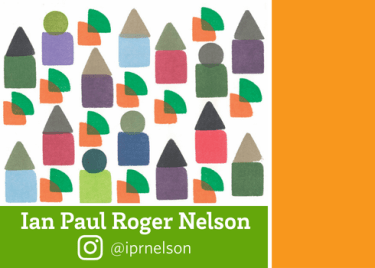
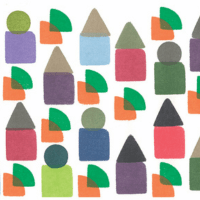
Ian Paul Roger Nelson creates art images on paper using rubber stamps and ink, each impression individually applied by hand. Ian’s work combines concepts of pattern with randomly generated elements, oftentimes employing shuffled playing cards or rolled dice to inform color and shape selection. Ian also manipulates basic building blocks into more involved representations of figures and objects, much like how one might arrange the polygon pieces of a tangram puzzle. These works have evolved from layered studies on color and negative space to more intricate ideas using cut-outs like inverted stencils to generate movement and depth.
Ian’s postcard is titled “Foundations.” In designing it, Ian says he made a “variation of something I made a couple years ago called People & Places which used some simple shapes to create forms—square with circle on top (people) and square with triangle on top (places). In that piece I used uniform colors for the people and for the places, but for this postcard I diversified the palette—because us people are all the same and also we are all different. Likewise the places where we choose to meet can be different in a physical sense but their purposes are often the same—a location to gather and engage in a shared experience such as a house or apartment or restaurant or gymnasium or theater or park. Interspersed among the people and the places are another simple form—two overlapping quarter circles in orange and green, representing a carrot. This form represents the Survival Center’s logo and, more generally, the food that we eat—one of what I consider the three building blocks or “Foundations” of community—people, places, food. If you’ve got your people around you and you’re able to congregate somewhere and you’re able to share a meal then you’re well on your way to establishing community.”

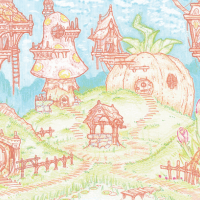
Brett Kelley is an independent creative living in Northampton. For the last eleven years, Brett has focused his illustrative and graphic design work on local and national efforts, including mural work, logo/creative design for valley businesses, and tabling at art markets.
He is currently preparing his first solo gallery exhibition, slated for October in Eastworks later this year.
He says hi.

Leanna Oen is a visual artist from California, now living in Western Massachusetts. Leanna is inspired by medieval illuminated manuscripts, Looney Tunes backgrounds, and Godzilla. She works primarily in acrylic paint, pen, and ink; please do not ask her to work with watercolor. Leanna finds great joy and satisfaction in community building and engaging with people.
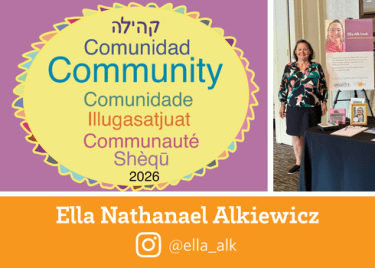
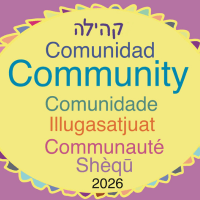
Ella Nathanael Alkiewicz, MFA is a beneficiary of Nunatsiavut kavamanga and a dual citizen. She is a self-taught visual artist and poet and trained at university for teaching, journalism, and writing. Alkiewicz utilizes all these skills for her small business, Ella Alk Inuk, LLC, and is an active investor of the Greater Northampton Chamber of Commerce since July 2024.
Her artwork is in You Were Made for This World (Tundra Books, 2025) and shows/sells across Massachusetts and in Istanbul, Turkey, Toronto, Ontario, and Bulgaria. She read her poem, “All Four Directions,” aloud at Quincy Market in November 2025. Other poems have been published in Smith College Museum of Art, Lucky Jefferson, and others. She’s taught workshops for University of Massachusetts Amherst and Boston, Mount Holyoke College, and will teach for Sojourner Truth School for Social Change Leadership in March 2026. Her articles have been published in Cultural Survival and Inuktitut.
Alkiewicz is honored to be in the Who’s Who in America by Marquis for 2025-26 and featured in the November 2025 issue of Northampton Living. She lives in Northampton with her husband of 13 years with tabby and has a beautiful grown kid living in Boston.
Ella lives by eight Inuit Principles that have carried Inuit for millennia. They are: InoKatigetsianik: respecting others, relationships, and caring for people; Tunngananik: fostering good spirit by being open, welcoming, and inclusive; Pijitsinik: serving and providing for family and/or community; ÂjeKatigennik: decision making through discussion and consensus; Pijagiutsanik: development of skills through observation, mentoring, practice, and effort; SuliaKatigennik: working together for a common cause; Kanuttogunnanik: being innovative and resourceful; and Avatittinnik kamatsianik: respect and care for the land, animals, and the environment. She says “these principles are incorporated in all aspects of food security and to me, the very definition of community. Community is everything.” Her postcard includes the word “community” in seven languages.
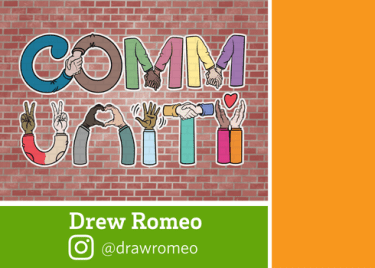
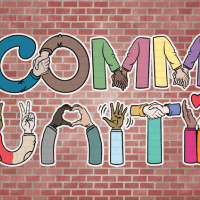
Drew Romeo has always considered himself as an illustrator. As a kid, he was constantly drawing—doodling, coloring, and practicing his penmanship. Though he later chose to pursue graphic design as a career, illustration never stopped being a central part of his artistic identity. He graduated from the Maine College of Art in Portland, Maine in 2009 with a BFA in Graphic Design. During college, he also discovered screen printing and other forms of printmaking, instantly falling in love with the process.
Now living in Easthampton, Drew built a career in the graphic design industry while continuing to illustrate and screen print in his spare time. About a decade ago, he began studying calligraphy and hand lettering, channeling his lifelong love of handwriting into a new art form. Today, his work blends all of these styles.
In early 2025, Drew left his design job of 11 years and decided to follow his true artistic passion by opening Printed Mass in Easthampton. The store and workshop features work from more than 30 local artists, including the clothing he and his wife design and screen print, as well as Drew’s own flat-stock prints.
As someone who recently reengaged with his community, Drew appreciated being part of the Gratitude Postcard Project. He says, “Being part of any community is an incredible feeling, but being able to give back to a community you love is indescribably rewarding. Somewhere along the way, I realized I had drifted from the artist community, and I found myself longing for that connection again. Watching my daughter develop her own passion for art and embrace her creative identity made that pull even stronger. I wanted to reconnect—for both of us. I wanted to dive back in, to show her the larger world of creativity, and to help bridge the artist community I cherish with the Western Mass community that shaped me and that I’m so grateful for. That’s what inspired me to open my shop, Printed Mass, in early 2025. I’m surrounded by incredible people and vibrant neighboring towns. This community is truly special, and I couldn’t be more thankful to call it home.”